
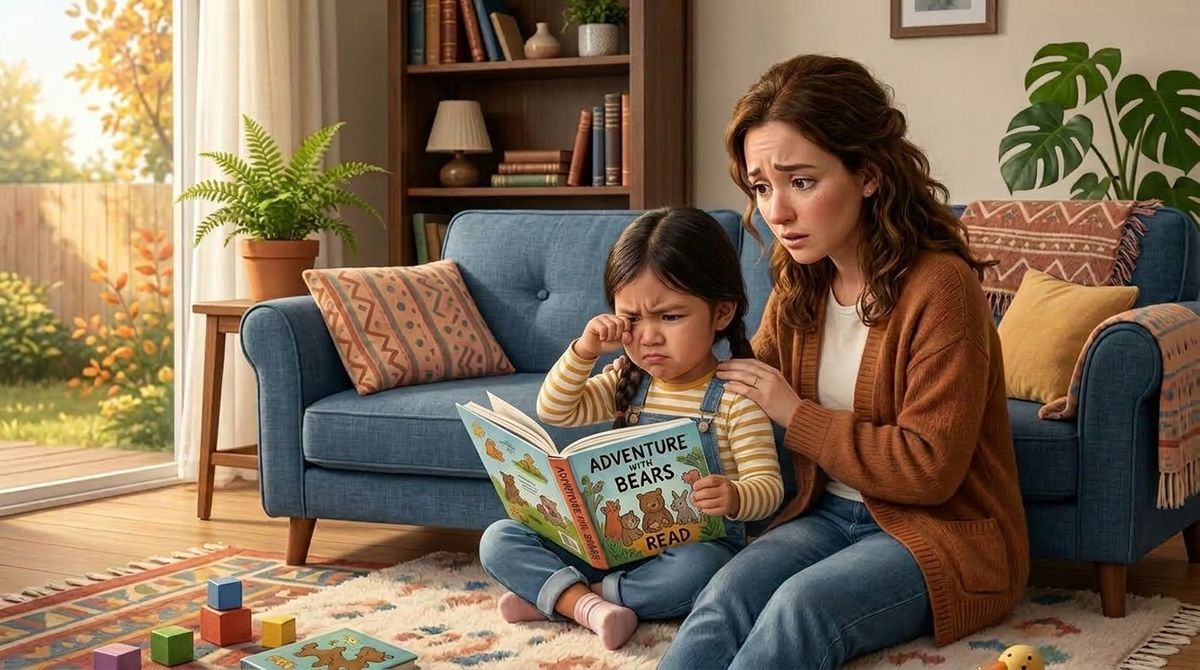
As a San Antonio parent, watching your child struggle with reading, homework meltdowns, or skipping lines on a page is heartbreaking — especially when they’ve already passed a standard 20/20 school eye exam. When your optometrist or occupational therapist recommends vision therapy, it’s completely natural to wonder, “Is this really what my child needs?”
The answer is often yes — but not for every child, and not for every problem. Here’s how to tell.
Reading Isn’t Just About Clear Sight
Reading isn’t just about clear sight. It requires complex visual skills like tracking, teaming, and focus. When those skills aren’t working smoothly, reading feels like a constant workout for a child’s eyes and brain.
Vision therapy works like physical therapy for the visual system, training the eyes and brain to work together more efficiently. It helps turn reading frustration into confidence — when the problem it treats is actually there.
That last part matters. The first step is never a program. It’s an evaluation that finds out whether a visual skill problem is part of what’s going on.
The Signs Worth Paying Attention To
Children rarely say “the words are moving.” They show you instead, through behavior. See if any of these sound familiar during reading or homework:
· Loses their place, skips lines, or re-reads the same sentence
· Uses a finger or marker to keep their place on the page
· Rubs their eyes, blinks a lot, or complains of headaches after reading
· Covers or closes one eye, tilts their head, or holds books very close
· Complains that words blur, move, or double — or that their eyes feel tired or sore
· Reads slowly or avoids reading, even though they understand material well when it’s read aloud
· Copies from the board slowly, or makes frequent errors copying
· Homework that should take 20 minutes stretches to an hour, and the effort seems to be the problem, not just the time
One or two of these signs doesn’t mean your child needs vision therapy. It means their visual skills are worth testing — because a standard 20/20 screening doesn’t test them.
The Three Skills Reading Depends On
To read comfortably, a child’s visual system has to coordinate three skills at once, for sustained periods, at 12 to 16 inches — not at 20 feet, where the eye chart lives.
1. Eye teaming (binocular vision). Both eyes have to point at the exact same spot on the page at the same time. If one eye drifts, the brain gets two conflicting images, and words can look doubled, shadowed, or like they’re swimming. The most common teaming problem is convergence insufficiency — difficulty holding both eyes turned inward comfortably for close work. Research funded by the National Eye Institute puts it at about 5% of children.
2. Eye tracking. Reading requires the eyes to make precise, tiny jumps from word to word across a line, then land accurately at the start of the next line. When tracking is weak, a child skips words, loses their place, or relies on a finger to stay on track.
3. Focusing stamina and flexibility. The eyes have to hold clear focus up close, and shift focus back and forth — from a desk notebook to the classroom board and back — without the words swimming or going in and out of focus.
A child can pass a 20/20 chart test with flying colors and still struggle with any of these. That’s why a school screening that says “perfect eyesight” can leave a parent feeling more confused, not less.
Who It’s For — and Who It’s Not For
Vision therapy is most likely to help when an evaluation finds a specific problem in one of those three skills — most clearly, symptomatic convergence insufficiency or a related focusing problem. For that diagnosis, supervised, office-based therapy has the strongest research behind it, including a National Eye Institute-funded trial in 221 children.
It is not a treatment for dyslexia or a learning disability, and it is not an ADHD treatment. A child can have both a vision problem and ADHD, or a vision problem and dyslexia — and fixing the vision problem can make close work less exhausting — but vision therapy doesn’t treat those conditions themselves. It also doesn’t correct nearsightedness, farsightedness, or astigmatism. Glasses still do that job.
A good provider should be able to tell you, before you start: what diagnosis they would be treating, what the research shows for that diagnosis, how progress will be measured, and when they would stop if it isn’t working.
What a Functional Vision Evaluation Checks
A functional vision evaluation looks beyond the eye chart. It tests how the eyes work together at reading distance, how accurately they track across a line, how well they hold focus, and how the visual system handles sustained close work — the conditions your child actually faces in the classroom.
If a problem is found, a program is built around that specific diagnosis. Most programs run for weeks to months, with weekly in-office sessions plus home activities. If no visual skill problem is found, we’ll tell you that too — and point you toward whatever the next step should be.
The Bottom Line
If your child has 20/20 eyesight but still struggles, resists, or hurts during reading, standard vision screenings aren’t enough. The question isn’t whether vision therapy works in general. It’s whether your child has a specific visual skill problem, and whether therapy is the right way to treat it. An evaluation is how you find out — without guessing, and without committing to a program first.
Call Vision Therapy of San Antonio at 210-822-0900 to book a functional vision evaluation, or visit visiontherapysa.com. We’re here to listen to your story, answer your questions, and help you figure out the next step.