
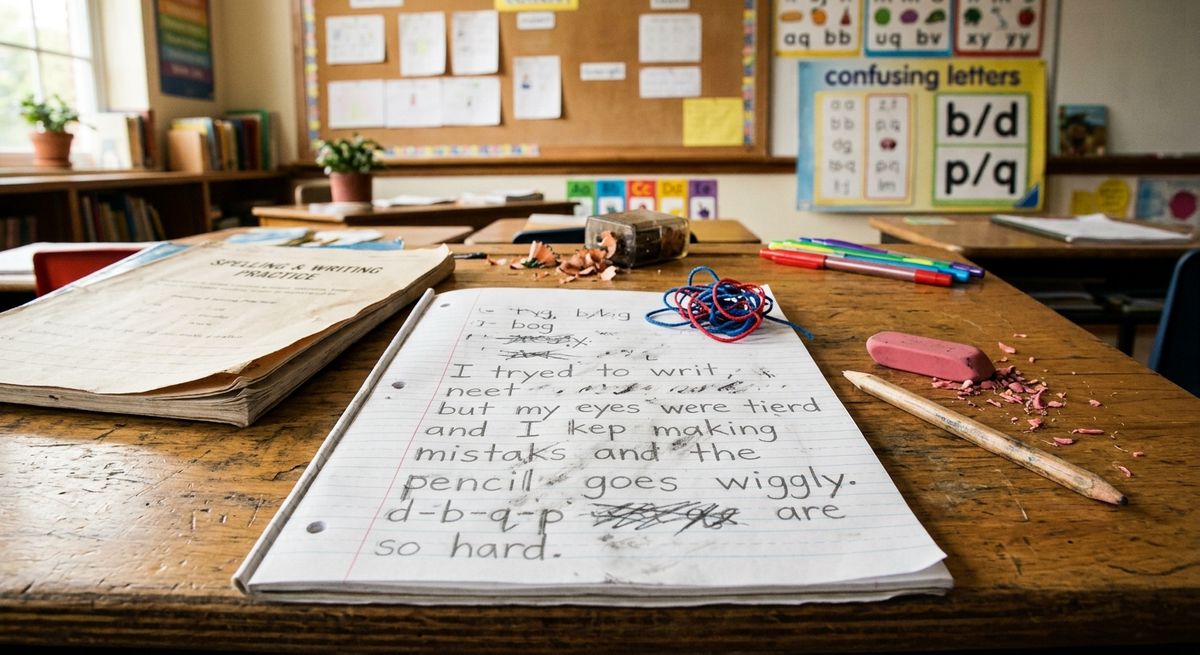
When a child struggles with messy handwriting, letter reversals, or taking an eternity to finish copy work from the board, the default assumption is often that they need more pencil-grip practice, fine motor work, or just "need to try harder."
However, as a functional vision specialist, I often see children who are bright, hardworking, and enthusiastic—yet their notebook pages tell a very different story.
What many parents, teachers, and even occupational therapists don't realize is that handwriting is primarily a visual-motor integration task, not just a hand-strength issue.
If the brain and eyes aren't working together efficiently, no amount of traditional handwriting drills will fix the root cause.
The Visual Skills Behind Neat Handwriting
We tend to think of vision simply as "20/20 clarity"—being able to read letters on an eye chart across the room. But reading and writing require functional visual skills that go far beyond basic visual acuity.
Here are the key visual skills required for fluent, neat handwriting:
1. Visual-Motor Integration (VMI)
Visual-motor integration is the ability of the brain to coordinate what the eyes see with the movement of the hands. When a child writes, their visual system must guide the fine movements of the pen or pencil. If there is a disconnect in this visual-motor pathway, handwriting becomes jagged, oversized, or improperly spaced.
2. Ocular Motor Control (Eye Tracking & Saccades)
Writing requires the eyes to make precise, continuous micro-movements across a page (and back and forth when copying from a textbook or whiteboard). If a child has poor tracking skills:
They frequently lose their place.
Spacing between words becomes erratic.
They skip lines or collide letters into one another.
3. Visual Spatial Orientation & Directionality
Knowing left from right, top from bottom, and how shapes orient in space is essential for proper letter formation. Children with underdeveloped spatial orientation often experience:
Persistent letter reversals (confusing b/d, p/q, or was/saw) past the age of 7.
Writing off the margins or sloping diagonally across an unlined page.
Inconsistent size relationships (mixing uppercase and lowercase letters randomly).
4. Visual Discrimination & Visual Memory
Visual memory allows a child to visualize a letter or word in their "mind’s eye" before writing it down. Visual discrimination helps them distinguish subtle differences between letters (like h and n or e and c). If visual memory is weak, writing is slow, laborious, and exhausting because every stroke requires conscious, deliberate thought.
Red Flags: Could Your Child’s Handwriting Be a Vision Problem?
If your child exhibits several of the following symptoms, an underlying visual skill deficit may be playing a role:
✏️ Exaggerated posture while writing: Tilting the head dramatically, resting the head on the desk, or covering one eye.
✏️ Inconsistent spacing & alignment: Words running together, erratic margins, or difficulty keeping letters on the baseline.
✏️ Frustration or physical fatigue: Complaints of sore hands, headaches, or avoidance of writing tasks altogether.
✏️ Slow, laborious writing speed: Taking significantly longer than peers to copy simple sentences.
✏️ Persistent letter & number reversals: Reversing letters or numbers well into 2nd grade and beyond.
How Vision Therapy Helps
Traditional handwriting practice focuses on repetition and fine motor mechanics. While helpful, if the underlying visual control system is weak, repetition only leads to frustration.
Functional Vision Therapy targets the root cause of these difficulties by retraining the brain and eyes to work as an integrated team. Through specialized, office-based activities and customized therapeutic exercises, vision therapy helps children:
Enhance visual-motor coordination and fine motor planning.
Smooth out eye movements and tracking for better alignment and spacing.
Strengthen visual memory and spatial orientation to eliminate letter reversals.
Make handwriting automatic, fluent, and stress-free.
Next Steps for Parents
If your child is struggling with messy handwriting, homework battles, or school-related frustration, standard sight tests often aren't enough—a child can pass a school 20/20 vision screening with flying colors while still suffering from severe functional vision deficits.
A Comprehensive Functional Vision Evaluation evaluates how the eyes work together, track, focus, and process visual information.
Ready to help your child succeed with confidence? Contact our office today to schedule an evaluation and see if vision therapy is the missing puzzle piece for your child.