
The Concussion Blind Spot: Why Your Child is Failing School Despite Being "Cleared" by a Doctor
Imagine a student returning to the classroom two weeks after a "minor" concussion. Physically, they appear to have made a full recovery—the bruising is gone, and the initial dizziness has subsided. But a month later, this once-honor-roll student is suddenly failing their classes. They aren’t just "tired"; they are experiencing a stabbing pain behind the eyes that makes every textbook page look like a blurry mess. They struggle to finish the simplest assignments, and their frustration is boiling over.
In the world of sports and school medicine, our standard recovery protocols are fixated on "brain rest"—limiting screen time and cognitive load. Yet, a growing body of evidence is sounding the alarm: we are systematically ignoring the primary way the brain interacts with the world: the eyes. Recent research reveals that the missing piece of the recovery puzzle isn't just about general cognitive fatigue; it’s about a fundamental, often invisible rewiring of a child's visual world that makes traditional learning nearly impossible.
The 3x Risk: Why Vision is the Ultimate Predictor of Academic Failure
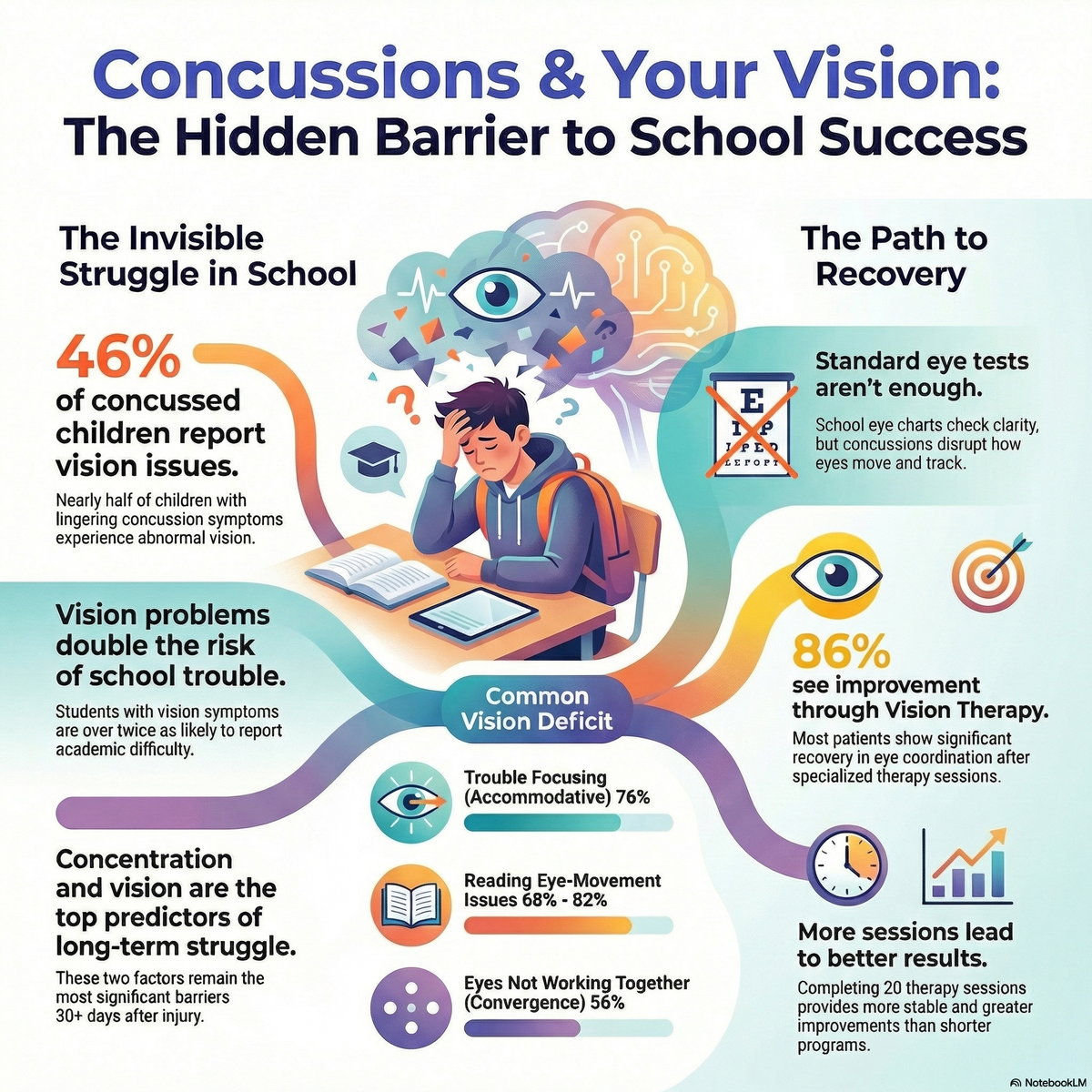
Vision is not merely a side effect of a concussion; it is a primary predictor of whether a child will sink or swim when they return to school. When researchers tracked 276 children at a specialized concussion clinic, as detailed in the Weise (2016) study, they found that nearly half (46%) reported visual abnormalities.
The data becomes even more haunting when we look at long-term recovery. For children whose symptoms persisted for 30 days or more, vision problems were one of the only remaining statistically significant predictors of academic difficulty, carrying an odds ratio (OR) of 3.15. This means a child with lingering visual issues is over three times more likely to struggle with schoolwork than their peers.
Perhaps most tellingly, the study found that "concentration difficulty" had a massive odds ratio of 15.33. As an investigative look into the data suggests, these aren't two separate problems. If a child’s eyes cannot focus or coordinate, their ability to concentrate is the first thing to collapse. This reveals a massive "blind spot" in modern protocols: we prioritize physical rest to prevent rare complications, yet we fail to assess the very visual functions required to process a whiteboard or a tablet.
"Despite growing evidence that vestibular-ocular and vision-specific dysfunction are common in children following concussion, vision is rarely mentioned in return-to-learn protocols." — Katherine Weise (2016)
The Two-Grade Level Drop: A Reading Crisis in Disguise
When a child’s eyes cannot coordinate, reading is no longer an automatic process—it becomes a Herculean task of survival. A retrospective analysis by Shelley-Tremblay (2015) used a tool called the Visagraph—an objective eye-tracking system—to look past what students said and see what their eyes were actually doing. The results were devastating: 68% of post-concussion patients were reading at least two grade levels below their actual school placement.
The study identified "oculomotor-based reading dysfunctions" in a staggering 68% to 82% of patients. To understand this, think of the eyes as the "hardware" through which the brain’s "software" receives information. The precision movements required to jump from word to word (saccades) and the ability to maintain focus on close objects (accommodation) are the brain's reading tools. A concussion effectively "blunts" these tools. If the hardware is delivery garbled, shaky, or exhausting data, the "CPU" of the brain is forced to overwork just to render the text, leaving zero processing power for actually understanding the history or math on the page.
Beyond "How Do You Feel?": The Move Toward Objective Sideline Testing
For decades, we have gambled with children's health by relying on a single, unreliable sentence: "I'm fine, Coach." Athletes are conditioned to hide symptoms, making subjective reporting a dangerous foundation for medical clearance. Investigative research is now moving toward objective measures like the King-Devick (K-D) test and high-speed Eye Tracking (ET).
According to research by Hans and Ventura (2014), the K-D test—a rapid number-naming exercise—captures "anticipatory saccades." These are the micro-movements your eyes make to predict where the next word on a page will be or where a ball will land. If you lose this "prediction" ability, the world feels like it’s "lagging." Furthermore, Goldenberg (2021) found that slowed visual reaction time was an ironclad diagnostic tool. The study reported a classification accuracy (AUROC) of 0.90—a "near-perfect" score in diagnostic science—for differentiating concussed athletes from healthy ones. Relying on self-reporting is a gamble we can no longer afford when an athlete's visual reaction speed tells the true story of their injury.
The Persistence of "Hidden" Deficits: A 12-Month Warning
One of the most dangerous myths of the "concussion era" is that being "cleared for play" is synonymous with being "fully recovered." A 2017 case study by Melissa Hunfalvay shattered this assumption. The study followed a 65-year-old patient, but the findings serve as a universal warning: these visual deficits do not discriminate by age, impacting everyone from honor-roll students to retirees.
Even after a full year of specialized therapy and the resolution of obvious physical symptoms like dizziness, the patient remained outside of normative ranges for nearly all oculomotor metrics, including smooth pursuit (the ability to follow a moving target) and fixation stability. This suggests that visual deficits can hide beneath the surface long after a doctor has signed a return-to-play form. We must stop viewing recovery as a finish line and start viewing it as a long-term physiological monitoring process.
"Quantitative and highly sensitive measures are needed to identify cases that do not fit clear symptomology and/or require ongoing monitoring." — Melissa Hunfalvay (2017)
The "86% Success Rate": The Power of Vision Therapy
While the data on deficits is sobering, the investigative trail leads to a solution that offers genuine hope. Vision Therapy (VT) is emerging as a transformative tool that can retrain the brain to see again, effectively turning a "permanent" academic decline into a treatable condition.
A study by Morandi on the efficacy of VT showed remarkable outcomes:
- 86% of patients saw clinically relevant improvements in their "near point of convergence"—the critical ability of the eyes to turn inward to focus on a book or screen.
- 48% average improvement in visual discomfort scores, as measured by the CISS (Convergence Insufficiency Symptom Survey).
- The "20-Session Sweet Spot": Researchers found that patients who completed 20 sessions of therapy had significantly better and more stable outcomes than those with shorter treatment durations.
This data transforms our understanding of concussion from a mysterious "black box" of cognitive symptoms into a treatable physical dysfunction. By retraining the eyes, we aren't just fixing vision; we are clearing the path for the brain to resume learning.
Conclusion: A New Lens for Concussion Recovery
It is time for a radical shift in how we view head injuries. A concussion is not just a "hit to the head" that requires a dark room and silence; it is often a measurable visual crisis. If a child is struggling to keep up in class after an injury, the problem likely isn't their intelligence or their work ethic—it is that their eyes are no longer providing their brain with a clear, stable picture of the world.
We must move away from the "wait and see" approach and embrace objective visual metrics. If we continue to treat concussions like the eyes don't matter, we risk leaving a generation of students to struggle in a visual world they can no longer navigate.
Final Thought: If half of our brain's circuits are involved in vision, why are we still treating concussions like the eyes are an optional part of the recovery?